2 December 2024
How to Close a Company in Thailand
Our team of Thai lawyers can provide you with legal advice and assistance if you need to close down a company in Thailand.

Local or foreign entrepreneurs who have opened companies in Thailand and, due to various reasons, prefer or have to shut down the business, should comply with a specific process that will require the assistance of professionals, such as accountants and lawyers. The dissolution of a Thai company is performed in accordance with the rules and regulations imposed by the Civil and Commercial Code.
Those who want to close a company in Thailand can receive assistance on this matter from our team of lawyers in Thailand, who can assist throughout the dissolution process.
General information on how to close a business in Thailand
In order to close a company, the directors are required to send notice (since February 2023 a newspaper notice is needed only if bearer shares were issued) that the shareholders of the business will meet in order to establish the conditions under which the company will be shut down. The newspaper announcement will target the company’s creditors, who will also be informed of this situation by mail.
The closing down of a Thai company involves two main steps:
• dissolution – a process through which the legal existence of the business is terminated;
• liquidation – a process referring to the payment of the company’s debts and distribution of the assets.
The procedure is performed with the assistance of a liquidator, appointed by the shareholders (by default the directors) or by the court in a compulsory winding up, and registered with the Department of Business Development (DBD), working under the Ministry of Commerce; our team of lawyers in Thailand can provide details on the requirements of the DBD.
| Quick Facts | |
|---|---|
| Applicable law(s) | – Civil Law, – Commercial Code. |
Conditions to liquidate a company | – limited lifespan of the company, – shareholders’ agreement, – completion of activities, – bankruptcy, – unlawful actions. |
Types of procedures | – voluntary, – compulsory/judicial procedures. |
| Voluntary company liquidation | Voluntary company liquidation in Thailand can occur at the end of a company’s life or when the shareholders reach a mutual agreement to terminate the business. |
| Compulsory company liquidation | Compulsory liquidation is possible when a Thai company becomes bankrupt or it breaks the law. |
| Appointment of a liquidator in a voluntary procedure | The liquidator is usually chosen among one of the company directors. |
| Appointment of a liquidator in a mandatory procedure | A Thai court will appoint a liquidator in the case of compulsory winding up. |
| Authorities to notify in case of liquidation | – the Trade Register, – the Tax Authority, – the Social Security Office. |
| Requirement to notify other parties (YES/NO) | Yes, the creditors must also be notified about a Thai company’s liquidation. |
| Notice requirements | 14 days. |
| Additional accounting requirements to comply with (if any) | Yes, the liquidator must draw up the last balance sheet, accounts, and financial statements. |
| Company liquidation time frame (approx.) | 6 – 12 months in the case of a voluntary procedure, longer in the case of a compulsory one. |
| De-registration with the Thai Revenue Department required (YES/NO) | Yes. |
| Trade Register deletion requirement (YES/NO) | Yes, this is the last stage in the company liquidation procedure in Thailand. |
| Company liquidation support (YES/NO) | Yes, you can rely on our Thai lawyers in closing a business. |
Company liquidation grounds in Thailand
Even if the shareholders may agree on winding up a Thai company at any time, there are usually serious grounds that lead to this decision. However, company liquidation can be voluntary, which is the case when the decision rests on the stakeholders, or mandatory, when it depends on a third party.
Here are the main reasons for which Thai companies can be closed:
- they were created for a limited time, which is also written in their Articles of Association;
- they completed their activities in Thailand and the shareholders decided not to pursue any other ventures;
- they become bankrupt;
- shareholders’ dispute no longer enable them to operate;
- they have broken the law and the Trade Register must withdraw their operating licenses.
These are some of the reasons why it is possible to close a company in Thailand. However, if you have a business facing other issues that may lead to liquidation, you can discuss your options with our Thai attorneys.
Company winding up steps in Thailand
No matter the way a Thai company will be closed, it must follow specific steps. In the case of the voluntary procedure, they consist of:
- informing the shareholders at least 14 days prior to a special meeting so they can attend it;
- holding the shareholders’ meeting, where 3/4 or 75% of the votes must be expressed in favor of closing the business;
- during the meeting, at least one liquidator must be appointed to handle the procedure.
When closing a company in Thailand voluntarily, more specifically a limited liability company, the procedure takes between 45 to 90 days to complete. This is not the case of compulsory proceedings.
In the case of compulsory proceedings, the decision is ruled in a court of law. So is the appointment of the liquidator. Due to the fact that this is a procedure mostly bankrupt companies undergo, it can take up to several years to complete.
If you need guidance on closing down a limited liability company, you can also rely on our law firm in Thailand for support.
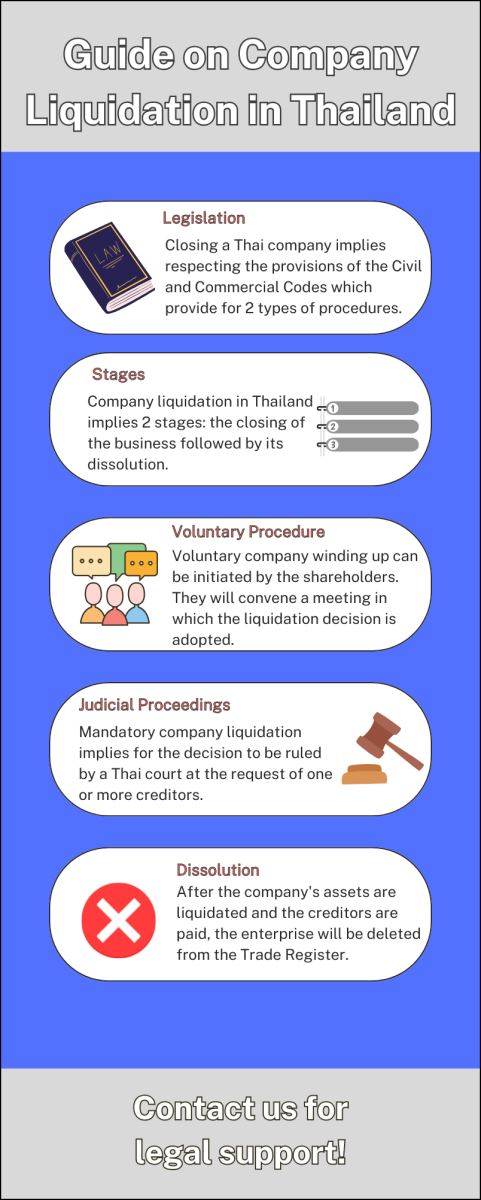
We also have an infographic on company liquidation in Thailand:
Final stages when closing down a business in Thailand
In order to close a company in Thailand, the representatives of the business have to comply with Value Added Tax (VAT) requirements. The liquidator must file a tax invoice for the assets the company still owns; the applicable rate is established at 7%.
Our team of lawyers can provide legal advice on the procedure related to human resources; if the company is closing down, the employees will have to be fired, a step which has to be performed before the official closing date.
The company will have to deregister from local authorities and inform the Social Security office of the current situation of the business.
It is compulsory to deregister from the Revenue Department, which will approve the procedure if the company does not have any payable pending taxes; our lawyers in Thailand can offer more details on this procedure.
Here is also a video on this subject:

Company closing statistics in Thailand
Recent data indicates that factories in the manufacturing sector have had financial difficulties in the past few years. In numbers, this means that:
- in 2022, 997 factories closed;
- in 2023, this number increased by about 34%, reaching 1,337 factories to shut down their operation;
- between January and May 2024, 561 factories closed, leading to 15,342 jobless people.
Our lawyers are also at the disposal of foreign investors and citizens interested in immigration to Thailand. For this purpose, our immigration lawyers can help them apply for residency in Thailand.
If you need further assistance on how to close a company in Thailand, please contact our team of lawyers for legal advice.